Hospital integration · InCor · 2023–2026
ECG classification at InCor
Heart Institute (InCor), Hospital das Clínicas, University of São Paulo Medical School
Objective
We built the classifier to help emergency department clinicians decide which ECGs to review first. Its predictions appear in the hospital application they already use.
My work
I developed the models and helped deploy the classifier in the emergency department. I coordinated the cardiologists' ECG annotations, including class definitions, review of conflicting readings and agreement analysis. After deployment, I helped evaluate the system with a cardiologist and compare it with specialists.
How it works
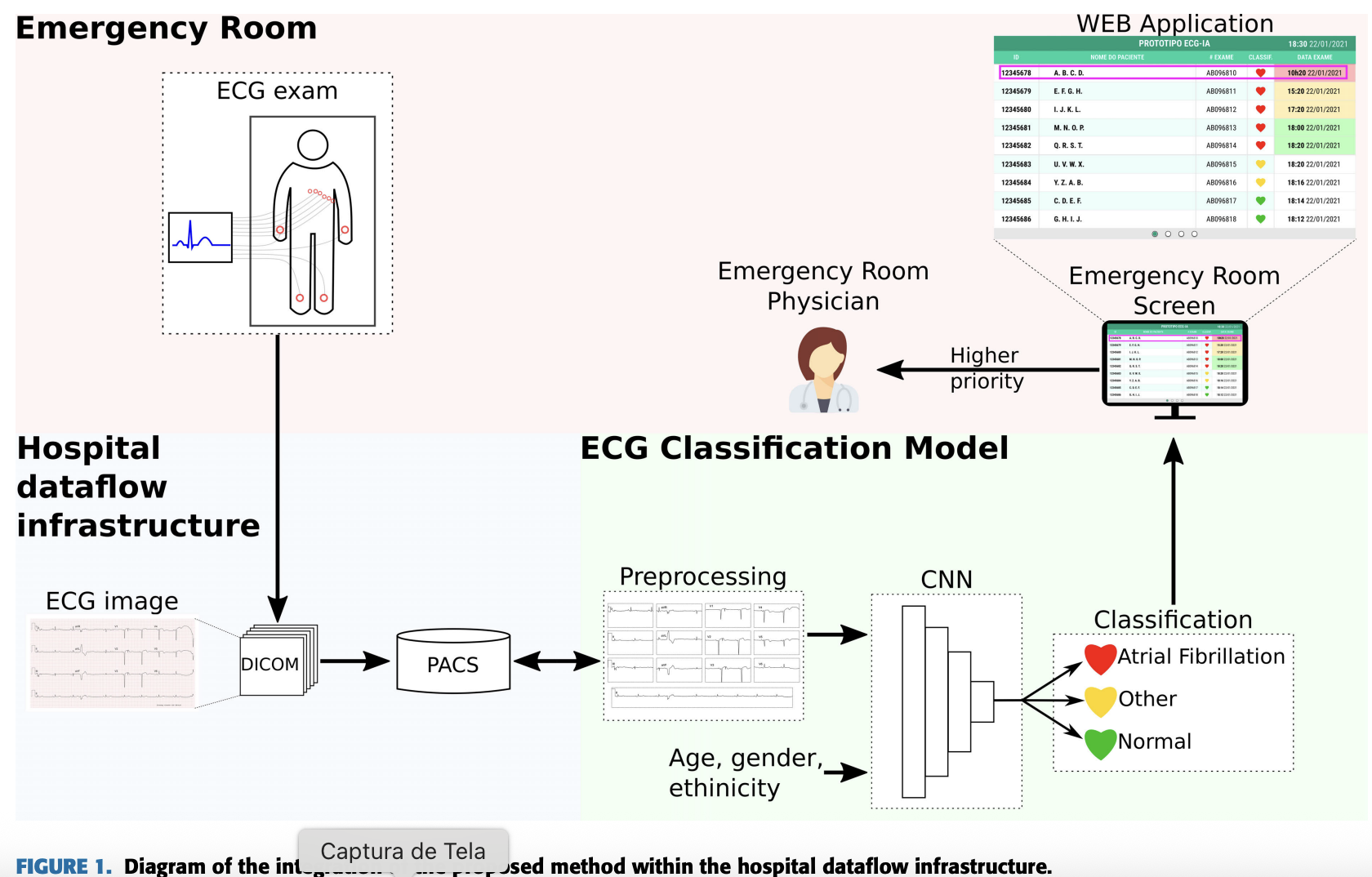
In the architecture published in 2023, 12-lead ECGs are stored in DICOM format in the hospital's picture archiving and communication system (PACS). The AI module retrieves the ECG, prepares the image and classifies it with a convolutional neural network. The figure also shows age, sex and ethnicity as inputs.
| Stage | Approach |
|---|---|
| Recording and storage | 12-lead ECGs stored in DICOM format in PACS. |
| Processing | Image preprocessing and classification with a CNN. |
| Output | Atrial fibrillation, other or normal. |
| Clinical use | Predictions shown in the emergency department web app to help clinicians prioritize ECG review. |
Results and evaluation
The 2023 version classified ECGs as atrial fibrillation, other or normal. We later developed a ConvNeXt ensemble for 12 categories. In the 2026 study of 18,519 ECGs from 14,402 patients, it achieved a macro F1 of 0.807 on the held-out test set (95% CI: 0.788–0.825).
Evaluation after deployment included cardiologist review and comparison with specialists. The figures above describe the research dataset and its held-out test results.
Related papers
- Dias FM, Ribeiro E, Soares QB, Krieger JE, Gutierrez MA. Image-Based Electrocardiogram Classification Using Pre-trained ConvNext. Computing in Cardiology, 2024.
- Cardona Cardenas DA, Ribeiro E, Soares Q, Dias F et al. Exploring the potential of DL for Chagas disease screening using chest x-rays. Physiological Measurement, 2026.
- Moreno R, Dias F, Arruda M et al. IoT Medical Device Architecture to Estimate Non-invasive Arterial Blood Pressure. Symposium on Internet of Things (SIoT), 2022.